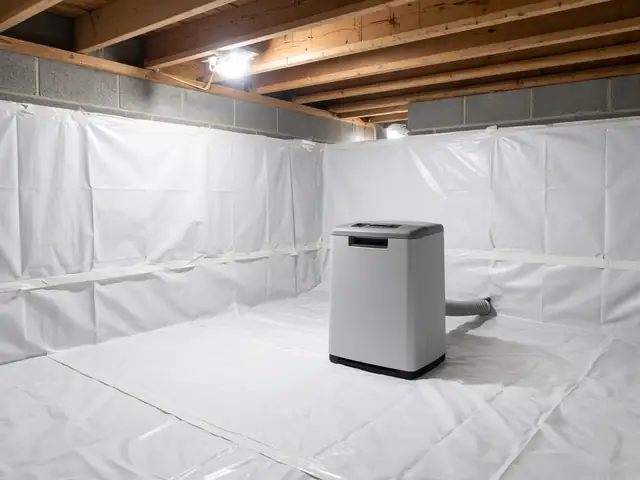
What crawl space encapsulation includes
- Inspection: moisture readings, wood condition, standing water, mold and pests.
- Prep: remove debris and old insulation, fix leaks, treat or replace damaged wood.
- Drainage if needed: an interior drain and sump pump where water collects.
- Liner: a heavy vapor barrier over the ground, run up the walls and around piers, with taped seams.
- Sealing: close vents, the access door and gaps to the outside.
- Humidity control: a crawl space dehumidifier or conditioned air.
- Insulation: often moved from the floor to the walls.
Crawl space encapsulation cost
| Item | National cost |
|---|---|
| Full encapsulation | $3 to $10 per sq ft; $3,000 to $15,000 typical total |
| 1,000 sq ft crawl space | $3,000 to $10,000 |
| 1,500 sq ft crawl space | $4,500 to $15,000 |
| 2,000 sq ft crawl space | $6,000 to $20,000 |
| Vapor barrier installed (ground only) | About $2 to $4 per sq ft |
| Crawl space dehumidifier, installed | $1,000 to $3,000 |
| Interior crawl space drain with pump | $800 to $3,000 |
| Sealing vents and holes | $150 to $450 |
| Crawl space mold remediation | $1,500 to $4,000 |
Figures are from HomeGuide's January 2026 national cost guide. Local quotes depend on square footage, height and access, how much cleanup and repair is needed, liner thickness and the dehumidifier chosen. Get the price broken out by line item so quotes are comparable.
Vapor barrier vs full encapsulation
| Vapor barrier | Encapsulation | |
|---|---|---|
| Covers | Ground only | Ground, walls and piers |
| Vents | Usually left open | Sealed |
| Humidity control | None | Dehumidifier or conditioned air |
| Best for | Dry crawl spaces with mild ground moisture | Damp, musty crawl spaces, wood or mold problems |
| Cost | Lower | Higher |
Crawl space dehumidifiers
Once a crawl space is sealed, moisture can still come from air leaks, plumbing and the house above. A crawl space dehumidifier is sized to the space, drains to a pump or the outside, and runs on a humidistat. EPA recommends keeping indoor relative humidity below 60%, and ideally 30% to 50%. Ask what humidity the system is set to hold, how the condensate drains, and what the filter and maintenance schedule is.
Why encapsulation is common in Charlottesville
Central Virginia summers are humid, and many local homes built before 1980 have vented crawl spaces. Humid outdoor air comes in through the vents and condenses on cooler ducts, pipes and joists. USDA data shows a shallow water table on about 5% of the city and 8% of Albemarle County, and 19% of the city's mapped soils are wet enough to need drainage. Those homes are the ones where musty smells, mold on joists and cupped floors show up.
Fix these first
- Gutters and downspouts that drain near the foundation.
- Soil sloping toward the house.
- Plumbing leaks.
- Rotted or moldy framing (see crawl space repair).
Radon and sealed crawl spaces
Albemarle County is EPA radon Zone 2 (moderate). Sealing a crawl space can change how radon moves into the home. Test before and after the work; if levels are high, a radon fan can often be added under the liner.
Questions to ask about an encapsulation quote
- How thick is the liner, and is it sealed to the walls and piers or just laid down?
- How are the vents and the access door sealed?
- What dehumidifier is included, what humidity will it hold, and where does it drain?
- Is a drain or sump included if water collects?
- What happens to existing floor insulation?
- How are termite inspections handled with a sealed liner on the walls?
- What are the warranties on the liner, the dehumidifier and the labor?
Frequently asked questions
How much does crawl space encapsulation cost?
HomeGuide's national data puts encapsulation at about $3 to $10 per square foot, or $3,000 to $15,000 total for most homes, with larger crawl spaces running higher. A ground vapor barrier alone runs about $2 to $4 per square foot installed.
What is the difference between a vapor barrier and encapsulation?
A vapor barrier is a plastic liner on the ground. Encapsulation goes further: a heavier liner sealed up the walls and around piers, closed vents, sealed gaps, and usually a dehumidifier or conditioned air, so the crawl space becomes a dry, closed space.
Does an encapsulated crawl space need a dehumidifier?
In a humid climate like Central Virginia's, usually yes, or a supply of conditioned air from the HVAC system. The liner blocks ground moisture, but humidity can still build from air leaks and plumbing.
How long does crawl space encapsulation last?
Heavy liners are made to last for many years when they are not punctured. Dehumidifiers are mechanical and will need maintenance and eventual replacement. Ask for the liner and equipment warranties separately.
Is crawl space encapsulation worth it?
It can be when the crawl space is damp, smells musty, has wood damage or makes floors cold. Fix gutters and grading first. It is less useful on a crawl space that is already dry and well drained.
Should I test for radon before sealing a crawl space?
It is a good idea. Albemarle County is EPA radon Zone 2 (moderate). A test before and after encapsulation shows whether radon mitigation should be added.
Do I need to fix mold first?
Yes. Moldy or rotted wood should be cleaned or replaced and the area dried before the liner goes in. Larger mold areas call for a professional.
How it works
- Tell us what you are seeingTwo minutes: cracks, sloping floors, sticking doors or water. Photos can come later.
- A local specialist contacts youUsually within one business day, to schedule a free inspection at your home.
- Get your written quote, then decideSee what is wrong and what it costs. You decide whether to go ahead.
Request your free foundation inspection
Tell us what you are seeing. A local specialist will contact you, usually within one business day. No obligation.
Sources
- HomeGuide, crawl space encapsulation cost (Jan 2026, national): https://homeguide.com/costs/crawl-space-encapsulation-cost
- USDA soil survey summary for Charlottesville city (foundationsoils.com): https://foundationsoils.com/va/charlottesville-city/
- USDA soil survey summary for Albemarle County (foundationsoils.com): https://foundationsoils.com/va/albemarle-county/
- BasementSoil, Charlottesville city soil drainage: https://www.basementsoil.com/basement-risk/charlottesville-city-va.html
- EPA, A Brief Guide to Mold, Moisture and Your Home: https://www.epa.gov/mold/brief-guide-mold-moisture-and-your-home
- EPA map of radon zones: https://www.epa.gov/radon/epa-map-radon-zones
- Virginia Department of Health, radon: https://www.vdh.virginia.gov/radiological-health/radon/