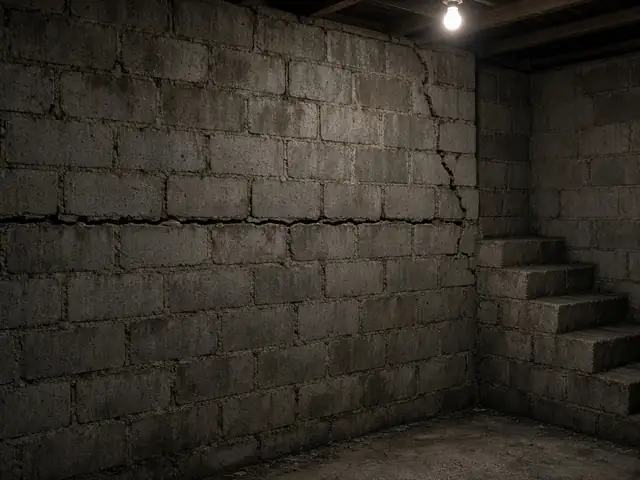
Signs of a bowing or leaning basement wall
- A horizontal crack running along a mortar joint about halfway up a block wall.
- Stair-step cracks at the ends of the wall.
- The top of the wall leaning in, or blocks shifted out of line.
- Water or efflorescence (white powder) along the crack.
- A gap between the top of the wall and the sill plate or floor framing.
What causes bowing walls in the Charlottesville area
Bowing is mostly a water problem here. USDA data shows little expansive clay in Charlottesville city, but saturated soil is heavy and pushes on a wall, and in winter, wet soil that freezes adds pressure. Downspouts that empty next to the wall, soil that slopes toward the house and blocked footing drains all keep the soil next to the wall wet. Older concrete block walls, common in homes built before 1980, are more prone to bowing than poured concrete walls because the mortar joints are the weak line.
Repair options compared
| Method | How it works | National cost |
|---|---|---|
| Wall anchors | Steel plates inside, anchors buried in stable soil outside, connected by a rod; can be tightened over time | $80 to $150 per linear foot |
| Steel or carbon fiber straps | Bonded or bolted to the wall from floor to framing to stop further movement | $85 to $280 per linear foot |
| Helical tiebacks | Helical anchors screwed into soil outside the wall, for more severe bowing | $300 to $360 per linear foot |
| Wall straightening or rebuild | Excavate, push the wall back, reinforce or rebuild it | $340 to $550 per linear foot |
Figures are HomeGuide national averages (2025). Local quotes can differ. Anchors and straps are generally suited to minor bowing; HomeGuide notes anchors are typically used for walls that have moved less than about 2 inches. Larger movement may need tiebacks, straightening or a rebuild, and an engineer's design.
What a good repair plan includes
- A measurement of how far the wall has moved, ideally recorded so it can be checked later.
- The method, the number of anchors or straps, and the spacing.
- Drainage fixes outside: downspout extensions, grading, and sometimes a footing drain.
- Crack sealing or interior drainage if the wall also leaks.
- Whether a permit or engineer's letter is included.
- The warranty and whether it transfers to a buyer.
Why acting early saves money
A wall that has only started to move can often be stabilized with straps or anchors in a day or two. A wall that has moved several inches may need excavation and rebuilding, which can cost several times as much. If you see a new horizontal crack, mark its ends and the date, measure how far the wall leans with a level, and request an inspection.
Related: foundation crack repair, basement waterproofing and foundation repair cost.
Block walls vs poured walls
Concrete block walls are built from units joined by mortar, so pressure tends to open a horizontal crack along one joint and push the middle of the wall inward. Poured concrete walls are one piece and resist bending better, but they can still crack horizontally or tip in at the top under enough pressure. The repair method depends on which you have: straps and anchors are common on block, while poured walls may also be braced with steel beams or carbon fiber.
How to measure a bowing wall
Hold a long level or a straight board against the wall from floor to ceiling, or hang a string line with a weight from the top of the wall, and measure the gap at the widest point. Write down the number and the date, mark the spot, and measure again in a month. A wall that keeps moving needs attention sooner than one that has been stable for years. The inspector will take their own measurements, but your record helps show whether the movement is active.
Permits and engineering
Wall stabilization is structural work, so a building permit is commonly required under the Virginia Uniform Statewide Building Code. Larger repairs, such as tiebacks, straightening or rebuilding a wall, may need an engineer's design. Ask whether the quote includes the permit and any engineering letter.
Frequently asked questions
Is a bowing basement wall dangerous?
It can become dangerous if it keeps moving, because a wall that leans far enough can fail. Most bowing is caught early, when anchors or straps can stop it. Have any inward bow or horizontal crack inspected soon rather than waiting.
How much does bowing basement wall repair cost?
HomeGuide's national data puts wall anchors at about $80 to $150 per linear foot, steel or carbon fiber straps at $85 to $280, helical tiebacks at $300 to $360, and wall straightening at $340 to $550. A 20-foot wall runs roughly $1,600 to $11,000 depending on the method.
Can a bowed wall be pushed back straight?
Sometimes partly. Wall anchors can be tightened gradually over time, and some contractors excavate and straighten a wall. Straps and braces mainly stop further movement rather than straightening the wall.
Should I buy a house with a bowing basement wall?
Get a repair quote, and for a significant bow an engineer's opinion, during your inspection period. The cost and the warranty can then be part of your negotiation.
Does insurance cover bowing walls?
Usually not, since bowing from soil pressure is treated as gradual damage. Check your policy and ask your insurer.
How it works
- Tell us what you are seeingTwo minutes: cracks, sloping floors, sticking doors or water. Photos can come later.
- A local specialist contacts youUsually within one business day, to schedule a free inspection at your home.
- Get your written quote, then decideSee what is wrong and what it costs. You decide whether to go ahead.
Request your free foundation inspection
Tell us what you are seeing. A local specialist will contact you, usually within one business day. No obligation.
Sources
- HomeGuide, bowing basement wall repair cost (Oct 2025, national): https://homeguide.com/costs/bowing-basement-wall-repair-cost
- HomeGuide, foundation crack repair cost (Jul 2025, national): https://homeguide.com/costs/foundation-crack-repair-cost
- USDA soil survey summary for Charlottesville city (foundationsoils.com): https://foundationsoils.com/va/charlottesville-city/
- Charlottesville city housing, median year built 1967 (ACS 2023 via City Stats): https://city-stats.com/virginia/counties/charlottesville-city/housing/